Monday, 9 November 2015

Did you know

did you know


Picture
Digital Citizenship is a concept which helps teachers, technology leaders, and parents talk about what all users should know regarding appropriate technology use. Digital Citizenship is more than just a teaching tool; it is a way to prepare students/technology users for a society full of technology. Too often we see students as well as adults misuse and abuse technology because they are unaware of what is appropriate. Our goal for this lesson is to help you become aware of what is appropriate and what could be harmful.
About Digital divide and digital Access

Reference

Reference page


This is page where I show all the links to the information I have been blogging about.
  • The independent Institution of Education, 2015. Digital Citizenship Module Manual.1ST ed.

Nine elements of citizenship

The nine elements of digital citizenship*

www.sec-ed.co.uk
1, Digital Access: As rapidly as internet access and technology have grown, socio-economic status and geographical location still play a part in keeping some from having digital access. It is important to remember that some still face these challenges and to help take steps to ensure that digital technologies continue to become more accessible.

2, Digital Commerce. Everything from groceries and toys to cars and electronics are available for purchase online. Consumers, including students, need to be informed and aware of the risks associated with online purchasing. Secure payments and sites that protect buyer information are important principles to teach.

3, Digital Communication. With email, text-messaging, video chat and more, communication is easier than ever before. With the push of a button or the click of a mouse, sensitive information can be shared unsafely. Warning students about what is appropriate to share through digital channels can prevent embarrassing, costly and dangerous situations.

4, Digital Literacy. Being an informed citizen is a large part of being a responsible citizen, not to mention that the more digitally literate students are, the better prepared they will be for the workplace or higher education. How to conduct online research, determine reliable sources, and use word processing software are all important skills.

5, Digital Etiquette. Just like it is imperative that students learn how to appropriately conduct themselves in the classroom, on the playground, and throughout the school, they need to learn how to be appropriate while online. More than just establishing policies about what is acceptable behaviour, students should be taught the importance of being respectful to their online peers and how to conduct themselves responsibly.

6, Digital Law. With new developments come new laws and restrictions. As technology has advanced, legislation has raced to keep up, resulting in ever-evolving rules and regulations. Teachers and students need to be informed and up-to-date about what is legal and acceptable.

7, Digital Rights and Responsibilities. Just as the citizens of many countries are afforded basic rights, those who participate in online activity are also given freedoms in their digital environment. Privacy rights and freedom of speech are often discussed and viewed as paramount.

8, Digital Health and Wellness. Out of the world’s estimated seven billion people, six billion have access to mobile phones (Source: TIME Newsfeed). Statistics like this make it clear that many of us spend hours a day looking at screens, typing on keyboards and talking on mobile phones. Safe ergonomic practices and eye safety are physical concerns that should be addressed.

9, Digital Security. We teach children to look before they cross the street, not to talk to strangers, and who to call in an emergency. Similar precautions are necessary within the digital community, including how to set robust passwords, virus protection, and how to determine site security

Five fluences and their relevance

Five fluencies and their relevance
www.blogsport.co.za

Media fluency

In the past the most powerful technology for communication was the printing press. However, today we have such a vast array of accessible and relatively inexpensive digital technology that allow us to produce images, video and audio content with relative ease.
In the communication’s learning unit we will explore this in more detail, but for this section of digital literates we need to understand how to interpret media.
Media fluency is actually two-fold, the first involves the interpretation (listening) of the media; the second, involves how we leverage this for our own output (communication).
This fluency involves both the communication aspect, as well as the literacy. We cannot produce something without knowing how to use the technology, but we cannot leverage the message without understanding this. Therefore, there may be some repetition between the two units..(IIE Module Manual DIGC5110)

Collaboration fluency

All over the world there are people who are communicating and working together…yet they may never meet face to face! The reality is with today’s technology, distance has become a concept that is relative. The authors of the book “Literacy is not enough” (Jukes, Churches, Crockett, 2011) worked on an entire project without ever meeting face-to-face until after the completion thereof! So how did they do it? Well, they had already mastered the skill of collaboration as well as being digitally literate. In this section we will look at the steps involved with the process.(IIE Module Manual DIGC5110)

Solution fluency

Technology has changed our lives drastically in the last 20 years and with these changes new needs have been identified. These needs range from personal to business, and with this we see new possibilities and opportunities. This has resulted in new job opportunities in fields of business that previously did not exist. So how do we learn for careers that don’t yet exist or are so new that there are no qualifications available to teach us, guide and prepare us for? We can’t! However, we can learn the skills that will help us adapt to these opportunities; essentially learn how to learn. The skill that would help the most here, although the fluency skills are all interlinked, is the solution fluency skill..(IIE Module Manual DIGC5110)

Information fluency

We have established that there are a lot of websites and pages available on the Internet, with more and more being added every day. The amount of readily available information is incredible to even try to imagine. This is often referred to as the InfoWhelm; the bombardment of information, much of which is irrelevant and useless. As a result of this rapidly increasing volume of information, facts become obsolete far quicker, with the knowledge built on those facts becoming less durable. (IIE

Additional resouces

Additional Resources


Digital SecurityIt is the responsibility of each Client to read and understand this legal notice and the terms and conditions pursuant to which an acquisition of financial contracts via this site is governed.
Digital Etiquette
Code of conduct:
1. Remember the Human
2. Adhere to the same standards of behavior online that you follow in real life
3. Know where you are in cyberspace
4. Respect other people’s time and bandwidth
5. Make yourself look good online
6. Share expert knowledge
7. Help keep flame wars under control
8. Respect other people’s privacy
9. Don’t abuse your Power
10. Be forgiving of other people’s mistakes
Penalties:
Banning the people who doesn’t apply the netiquette knowledge
Reporting them to the police
How I would enforce and manage this in my business
I would do check ups once a week or I would employ a person just to handle and deal with those problems in my business.

digital citizenship and digital access

Digital citizenship and digital access


Physical access
In digital divide is the challenge of being able to physically access the technical universe be it the Internet or just simply a computer.
Cognitive access
In digital divide is lacking the skill needed to be able to work on these technical machines regardless if one has the physical access. These are two dimension that digital divide is divide into.
The following will be the 9 elements that one finds in digital citizenship and their relevance to a social, knowledge capital and human capital
Digital access is the full participation in society. This in relation to social capital is the ability to connect to people around the world with the use of social media. In relation to knowledge capital it is the ability to access the Internet to gain knowledge and for educational reasons. In relation to human capital it is the ability to gain access to business websites.
Digital commerce this is the electronic buying and selling of product. This in relation to social capital is the ability to trade products and even services online via the use of social media. In relation to knowledge capital it is the ability to buy books and stationery online to assistance to a learner for educational reasons. In relation to human capital is to access to a business website to be able to buy their product.
Digital communication this is the exchange of information electronically. Social capital is the ability to share information online via social media. Knowledge capital is the ability to gain information to do research for projects and assignment for school, university and colleges. Human capital this is the ability to gain information about a product online or even for the business to gain information about their customers.
Digital literacy this is the process of learning about technology and how to use it. Social capital is the ability to connect with others who can teach you about how to use technology. Knowledge capital is the ability to interact online to learn about technology. Human capital is the ability to post video tutorial online to help people use their products and thus educate them on how to use technology.
Digital etiquette this is the standard of electronic conducts or procedure. This in relation to social capital is teaching people how to use social media in a proper manner. In relation to knowledge capital is teaching students and even adults how to use not only social media but all forms of digital communications to remain in a proper manner. In relation to human capital is to ensure that there is a set standard of communication within the workplace when it comes to digital communication.
Digital law this is the responsibility for actions and deeds performed electronically. This in relation to social capital is to know that actions on social media can be held against you if it crosses legal boundaries. In relation to knowledge capital is teaching people to reference work when they do assignments and other forms of research. In relation to human capital is the legal rights that a business has and has to adhere to when going digital.
Digital right and responsibilities these are known as the freedom that is extended to everyone in the digital world. This in social is to knowing your rights and responsibilities that go with these rights when using social media. In relation to knowledge capital it is to stay educated about ones rights and responsibilities along with being taught the difference between right and wrong. In relation to human capital it is the businesses rights and responsibilities regarding their digital footprint and what they do online.
Digital health and wellness this is the psychological and physical well-being of the digital world. This is having restrictions on line to prevent youngsters from gaining access to things that can affect their psychological well-being along with watching what you say , post and even share online and between private conversation as it can all somehow come right back around and haunt you. In relation to knowledge capital is to teach other what is right and wrong online and how to respect themselves enough to not do something they may later regret. In relation to human capital is the businesses responsibility to not do things that can affect someone’s well-being online.
Digital security this is the electronic precautions to guarantee safety online. This in relation to social capital is to keep all private information to yourself online. To not share anything that can cause you legal or other problems later along the online. In relation to knowledge capital is to teach kids from a young age what may and may not be shared online in order to protect them from being stalked or worse. In relation to human capital is the businesses responsibility to not share their customer’s private information.
It is important to know what data, information and knowledge is when looking at the above mentioned elements.
Data: defined as a collection of information.
Information: defined as processed data.
Knowledge: defined as a compilation of information and experience.
South Africa is a developing country and therefore faces education issues. Schooling is vital for knowledge to be obtained. Not all South Africans have the knowledge required to perform certain functions and tasks
Social capital. (n.d.).Collins English Dictionary-complete & Unabridged 10th Edition. Retried April 14, 2015 from Dictionary.com website: http://dictionary.refernce.com/browser/social capital

digital etiquette

Digital etiquette


Code of conduct
Remember the human meaning that the person reading your form of communication is human thus they have feelings. Therefore do not say things that you would never say to their face.
10 points of netiquette:
  • When communication or connecting with people electronically always be respectful. Treat other as you want to be treated.
  • Know you environment (cyberspace) and act or discuss accordingly.
  • Don’t stray from your norms and values act online as you will in real life.
  • Respect people time online, say what you want to say don’t overload on information, people are always time limited.
  • Share your expert knowledge, communicate and share about subject you have knowledge or interested in.
  • Online physical appearance don’t matter that much so it is important to look good with your language usage and writing.
  • Respect privacy, people block or privatize certain information for a reason and it is important to keep your nose out of such information.
  • People sometimes disagree online but it is important to control these wars and look for positive outcome.
  • It is easy to be cruel or mean when you’re sitting behind a computer screen with anti-hack software, this power you have is a privilege and should not be abused.
  • Just like in real life people make mistake and it is important to forgive people when they make these mistakes even online.
Penalties for failing to meet these points
  • Banning people permanently from certain group or site and others
  • Billing people misbehaving
  • Human right laws against cyber-bully
  • Give people the opportunity to report bad behaviour
  • Having people agree to terms and conditions before entering certain site to protect the site group and other, against court cases or false accusation.
  • Copyright laws and anti-plagiarism sites or groups keeping watch.
  • Blocking people from certain group, site and others.
  • Educate people on netiquette.
How to enforce and manage this business
  • Have employees sign a contract agreeing to Internet usage law and other.
  • Cameras tracking what people watch on their computers ( IT businesses)
  • Block certain sites on the computers.
  • Restrict Internet usage
  • Fees for disobeying.
  • Applications that control netiquette on business computers such as custom cloud and so on

digital rights and responsibilities

  • Reference page
  • Digital rights and responsibilities

    In this section I will be referring to the IIE http://www.rosebankcollege.co.za/ and giving them guidelines to which they should adhere regarding student.
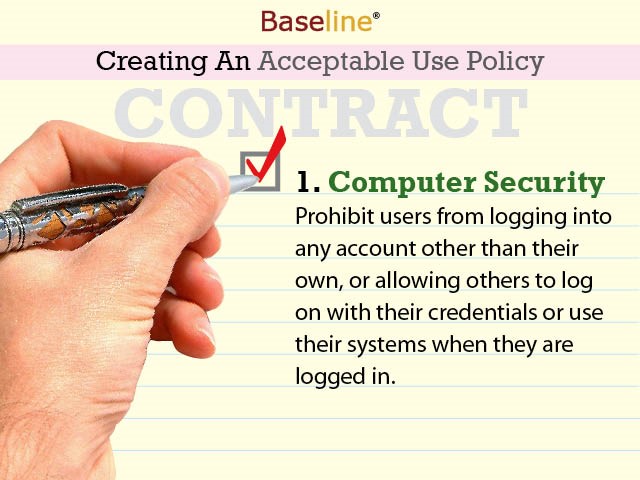
    Acceptable use policy
    Computer and or computer services are provided for educational purpose and research consistent with the educational mission, curriculum and instructional goal.
    m
    Student must comply with all board polices, school rules and expectations concerning student conduct and communication when using computers or computer services, whether on or off school property.
    Student also must comply with all specific instructions from school staff and volunteers when using the computers or computer services.
    Roles and responsibilities
    School will establish a periodic reporting requirement to measure the compliance and effectiveness of this policy
    The school is responsible for implementing the requirements of this policy, or documenting non-compliance via the method described under exception handling.
    All student are required to read and acknowledge the reading of this policy
    An acceptable use policy (AUP) is a policy that shapes, in writing, how a school network or internet connections used to access school or Internet-based information. Similar to terms of service document, an AUP should define publicly what is deemed acceptable behaviour from users of hardware and information systems such as the Internet and any application networks.
    Many schools address both acceptable and unacceptable online behaviour in their AUPs, but also defining positive goals for incorporating technology into the school day. Additionally AUPs also can help comply with E-rate requirements set forth by the children’s Internet Protection Act (CIPA).
    Today’s educators have the difficult job of maintaining the balance of protecting students while providing access to the digital world. Educators need to be comprehensive yet not limiting when creating a stimulating but safe learning environment. An AUP is a first step in framing these opportunities
    l
    Graves, A. (2015). What is acceptable use policy (AUP)? – Definition formWhatis.com. [Online]Whatis.com. Available at: http://whatis.techtarget.com/definition/acceptable-use-policy-AUP [Accessed21 may 2015].

    digital health and wellbeng

    Digital health and well-being


    If we had to put this section into categories we would split it into the physical issue and the psychological issues
    Physical issues: these are issue that arise from an overuse of technology and the internet they are as follows:
    Ergonomics: this is the science of designing environments and products to match individuals who use the. Studies have shown that sitting for long periods can increase the chances of developing some serious diseases such as heart disease, diabetes, cancer and obesity.
    Repetitive strain injury (RSI): this is a physical syndrome that develops over time after an action has been done repeatedly and thus damages or forms a particular muscle group. Some forms of RSI include carpal tunnel syndrome, tennis elbow, trigger finger and tendinitis.
    Eye strain: this is known as the most annoying syndrome as it affects one key area the eye. Two of type’s eyestrain that you can is computer vision syndrome and digital eye strain.
    Obesity: this is a syndrome that is not only caused by what you eat but also by the lack of physical activity. Thus sitting behind a desk for long durations is bad.
    Psychological issues
    These are issues that are harder to pick up. They are often misdiagnosed and hardly ever understood and sometimes they could lead to physical issues. They are as follows:
    Addiction: ever catch yourself checking your phone every 5 seconds? Yeah you have an acute addiction to your phone. Often it is not seen that way but most youngsters nowadays are constantly either on their phone or on the computer. This can sometimes even be as bad as an alcohol addiction depending on how badly the person relies on the phone or device.
    Cyber bully: this is where someone uses the World Wide Web to bully someone. It is not only bad for the person being bullied but for the person doing the bullying too.
    Cyber stalking: It is just as bad as bullying. This is where someone uses the World Wide Web to stalk someone and it often gets so bad that it becomes harassment.
    • The independent Institution of Education, 2015. Digital Citizenship Module Manual.1ST ed.
    Online disinhibition effect: this one is all about behaviour online. This is where people often are braver online as they do not have to actually face the person. Thus their personality is often a lot different and sometimes disrespectful
    The independent Institution of Education, 2015. Digital Citizenship Module Manual.1ST ed

    section for parants

    parent section


    good game for kids
    Cooking games can be fun for kids as they learn how to sequence tasks, measure ingredients, and manage their time. Mix up some of our favorite games, apps, and websites.

    digital literacy and information influency


    Digital literacy and information

    Animal planet

    ·         Animal planet is owned by discovery communication originally focused on more educationally based television shows, the reality programming since the late 2000, the purpose of the site and series is to educate people about the animals and the nature of the world, from different plants, soil and animals

    ·         The animal plants have been viewed or watched by many people from different countries , the public enjoy and love the documentaries shows and stories that the animals tells. More than 5  billion people views or explore pet and wild animals clips from the animal planet website

    ·         The is totally a big difference between the early years of the animal planet and now, back than they had few people following them or had any knowledge about them  but now they have grown , they have tv shows, their wild animal clips that are played at YouTube they also created animal planet games and they are big on social network such as Facebook, twitter and so forth.

    ·         They have grown a lot, they also have made the difference to the inter world by educating the up coming generation about the importance of taking care of the animals how people can protect themselves from wild animals, the importance of saving the worlds nature things like plants, rivers, dams the soil

    digital security


    Digital security

    One of the issues surrounding security is hacking where people can hack into someone’s personal computer and steel someone’s personal information or same time their bank details so that they can withdraw their capital

    Fraud is the second issue , a person is able to crash someone’s password and use his or her identity to achieve something (identity theft) 

    The is disaster fraud—victims get emails from organizations that work with area affected by some disaster (e.g. Haiti) they are requested to donate towards the funding of the organization

    1.       Theft of telecommunications services

    The phone phreaks of three decades ago set a precedent for what has become a major criminal industry, buy gaining access to the organizations telephone switchboard (PBX) individuals or criminal organization can obtain access to dial-in/dial-out cruit and than make their own calls or sell call time to third parties


    2.       Communication in furtherance of criminal conspiracies

    Just as legitimate organization in the private and public sectors rely upon information systems for communication and records keeping, so too are the activities of criminal organization enhanced by technology.


    3.       Telecommunications piracy

    Digital technology permits perfect reproduction and easy dissemination of print, graphics sound and multimedia combination


    4.       Dissemination of offensive materials

    For some time now, electronic funds transfers have assisted in cancelling and in moving the proceeds of crime emerging technologies will greatly in concealing  the origin of ill-gotten gains


    5.       Electronic money laundering and tax evasion

    For some time now, electronic fund transfers have assisted in canceling and in moving the proceeds of crime


    6.       Electronic vandalism, terrorism and extortion

    As never before, western industrial society is dependent upon complex data processing and telecommunication system


    7.       Sales and investment fraud

    As electronic commerce become more prevalent, the application of digital technology to fraudulent endeavors will be that much greater


    ·         Saves time

    ·         Make things easy to communicate with others

    ·         Share beautiful pictures

    ·         Share ideas


    Digital commerce

    digital commerce

    One of the most popular activities on the Web is shopping. It has much allure in it — you can shop at your leisure, anytime, and in your pajamas. Literally anyone can have their pages built to display their specific goods and services.
    History of ecommerce dates back to the invention of the very old notion of "sell and buy", electricity, cables, computers, modems, and the Internet. Ecommerce became possible in 1991 when the Internet was opened to commercial use. Since that date thousands of businesses have taken up residence at web sites.
    At first, the term ecommerce meant the process of execution of commercial transactions electronically with the help of the leading technologies such as Electronic Data Interchange (EDI) and Electronic Funds Transfer (EFT) which gave an opportunity for users to exchange business information and do electronic transactions. The ability to use these technologies appeared in the late 1970s and allowed business companies and organizations to send commercial documentation electronically.
    www.historyofecommerce.co.za

    The importance of being informed

    written by
    People can get along just fine without journalism. Read it because you like it, not because you feel you have to.Young people consider news to be garbage and lies according to Paula Poindexter’s research at the University of Texas at Austin. Because of that and for so many other reasons, Poindexter says, millenials are increasingly ill-informed. In fact, according to her research, they simply don’t feel being informed is important to start with.

    Guideline 1: An ethical writer ALWAYS acknowledges the contributions of others and the source of his/her ideas.
    Guideline 2: Any verbatim text taken from another author must be enclosed in quotation marks.
    Guideline 3: We must always acknowledge every source that we use in our writing; whether we paraphrase it, summarize it, or enclose it quotations.
    Guideline 4: When we summarize, we condense, in our own words, a substantial amount of material into a short paragraph or perhaps even into a sentence.
    Guideline 5: Whether we are paraphrasing or summarizing we must always identify the source of the information.
    Guideline 6: When paraphrasing and/or summarizing others’ work we must reproduce the exact meaning of the other author’s ideas or facts using our words and sentence structure.
    Guideline 7: In order to make substantial modifications to the original text that result in a proper paraphrase, the author must have a thorough understanding of the ideas and terminology being used.
    Guideline 8: A responsible writer has an ethical responsibility to readers, and to the author/s from whom s/he is borrowing, to respect others’ ideas and words, to credit those from whom we borrow, and whenever possible, to use one’s own words when paraphrasing.
    Guideline 9: When in doubt as to whether a concept or fact is common knowledge, provide a citation.
    Guideline 10: Authors who submit a manuscript for publication containing data

    www.plagiarism.co.za


    digital communication

    Digital communication


    In this section we had to look at the game clash of clans. Clash of clans is an online multiplayer game in which player build a community, train troops and attack other player to earn gold and elixir and dark elixir , which can be used to build defenses that protect the player from other players attacks, to train and upgrade troops. The game also features a single player campaign in which the player must attack a series of fortified goblin villages.
    Strategies: there are two phases in a clan war, the preparation day and the battle day. Each participant can attack twice during the battle day. At the end of the war the clan that earns the most stars from attacking wins the clan war.
    The logistics of the game is to join a clan and gain trophies. The game score function is to be a multiplayer game however you can play it in single player ode if you choose.
    Every clan member who makes successful attacks during a clan war will earn some bonus loot, but only the winning clan will receive a large loot bonus.
    p
    clash of clans http://blog.gameanalytics.com/blog/wp-content/uploads/2012/12/clash-of-clans.jpg
    My experience: I felt as though the game was interesting in the beginning and had me hooked although over time I lost interest since I kept on getting raided and couldn’t get more money to advance my objet which made me weak. Knowing what I know helps a lot since there are strategies to the game otherwise you struggle to advance.
    Communication used: the communication which was used was via an online chat whilst on the game. Some of the language used in this chat was horrendous and was often not even about the game. People would have normal conversation or end up fighting with one another on the chat site which was never useful but on the odd occasion strategies were discussed. This was inappropriate behaviour and communication.
    I feel as though this would not be educational for kids when it comes to digital citizenship except for the simple fact that one need to work together to defeat other. Other than the language used online isn’t child friendly and children of today should not be exposed to that at all, or it can educate children to be effective in communication.